Be yourself; Everyone else is already taken.
— Oscar Wilde.
This is the first post on my new blog. I’m just getting this new blog going, so stay tuned for more. Subscribe below to get notified when I post new updates.
Be yourself; Everyone else is already taken.
— Oscar Wilde.
This is the first post on my new blog. I’m just getting this new blog going, so stay tuned for more. Subscribe below to get notified when I post new updates.

Hey everyone, my name is K Chandra pursuing B Tech in Presidency University. I am from Hindupur. My hobby is to watch movies, go out for photoshoot, and long rides.
Space Pollution
More than 500,000 pieces of debris, or “space junk,” are tracked as they orbit the Earth. They all travel at speeds up to 17,500 mph, fast enough for a relatively small piece of orbital debris to damage a satellite or a spacecraft.
The rising population of space debris increases the potential danger to all space vehicles, but especially to the International Space Station, space shuttles and other spacecraft with humans aboard.
NASA takes the threat of collisions with space debris seriously and has a long-standing set of guidelines on how to deal with each potential collision threat. These guidelines, part of a larger body of decision-making aids known as flight rules, specify when the expected proximity of a piece of debris increases the probability of a collision enough that evasive action or other precautions to ensure the safety of the crew are needed.
B.Sainath Reddy
I am from Anantapur
SPACE POLLUTION
Section; PC10 iam pursuing b.tech from presidency university
That seemingly innocuous little screwdriver litters space, along with gloves, cameras, lens caps, an astronaut blankie, garbage bags, paint flecks, solid fuel, wrenches, nuts, bolts, a tool bag, a pair of pliers, and a toothbrush (don’t ask).
My hobbies is playing games
The problem is, the above space debris items are nothing compared to what’s also out there: obsolete spacecraft, chunks of satellites and rockets, momentum flywheels, nuclear reactor cores, and fragments of rockets that have broken up or collided with other objects.

Hey everyone, I am Vishal VM from bangalore, pursuing B.Tech in ELECTRONICS AND COMMUNICATION ENGINEERING in Presidency University. I have completed my intermediate in Bangalore. My hobby is to play volleyball, go for photoshoot, and going out for bike ride. I would like to pursue my Masters in abroad. I want to explore the world by going on for a long world trip and would like to go for trekking too.
Space Pollution
In the most general sense, the term space pollution includes both the natural micrometeoroid and man-made orbital debris components of the space environment; however, as “pollution” is generally considered to indicate a despoiling of the natural environment, space pollution here refers to only man-made orbital debris. Orbital debris poses a threat to both manned and unmanned spacecraft as well as the earth’s inhabitants.
Environmental and Health Impacts
The effects of debris on other spacecraft range from surface abrasion due to repeated small-particle impact to a catastrophic fragmentation due to a collision with a large object. The relative velocities of orbital objects (10 kilometers per second [km/s] on average, but ranging from meters per second up to 15.5 km/s) allow even very small objects—such as a paint flake—to damage spacecraft components and surfaces. For example, a 3-millimeter (mm) aluminum particle traveling at 10 km/s is equivalent in energy to a bowling ball traveling at 60 miles per hour (or 27 m/s). In this case, all the energy would be distributed in an area of the same size as the particle, causing cratering or penetration, depending on the thickness and material properties of the surface being impacted. There has been one accidental collision between cataloged objects to date, but surfaces returned from space and examined in the laboratory confirm a regular bombardment by small particles. Space Shuttle vehicle components, including windows, are regularly replaced due to such damage acquired while in orbit. Debris also poses a hazard to the surface of the Earth. High-melting-point materials such as titanium, steel, ceramics, or large or densely constructed objects can survive atmospheric reentry to strike the earth’s surface. Although there have been no recorded fatalities or severe injuries due to debris, reentering objects are regularly observed and occasionally found.
Debris is typically divided into three size ranges, based on the damage it may cause: less than 1 centimeter (cm), 1 to 10 cm, and larger than 10 cm. Objects less than 1 cm may be shielded against, but they still have the potential to damage most satellites. Debris in the 1 to 10 cm range is not shielded against, cannot easily be observed, and could destroy a satellite. Finally, collisions with objects larger than 10 cm can break up a satellite. Of these size ranges, only objects 10 cm and larger are regularly tracked and cataloged by surveillance networks in the United States and the former Soviet Union. The other populations are estimated statistically through the analysis of returned surfaces (sizes less than 1 mm) or special measurement campaigns with sensitive radars (sizes larger than 3 mm). Estimates for the populations are approximately 30 million debris between 1 mm and 1 cm, over 100,000 debris between 1 and 10 cm, and 8,800 objects larger than 10 cm.
The number, nature, and location of objects greater than 10 cm in size are provided in the fragmentation debris table and in the image of space debris around Earth. Low Earth orbit (LEO) is defined as orbital altitudes below 2,000 km above the earth’s surface and is the subject of the image of space debris around Earth. Middle Earth orbit (MEO) is the province of the Global Positioning System (GPS) and Russian navigation satellite systems and is located at approximately 20,000-km altitude, whereas the geosynchronous Earth orbit (GEO) “belt” is inhabited primarily by communications and Earth—observation payloads around 35,800 km. The majority of objects in these orbital regions are in circular or near-circular orbits about the earth. In contrast, the elliptical orbit category includes rocket bodies left in their transfer (payload delivery) orbits to MEO and GEO as well as scientific, communications, and Earth-observation payloads. Of all objects listed in the
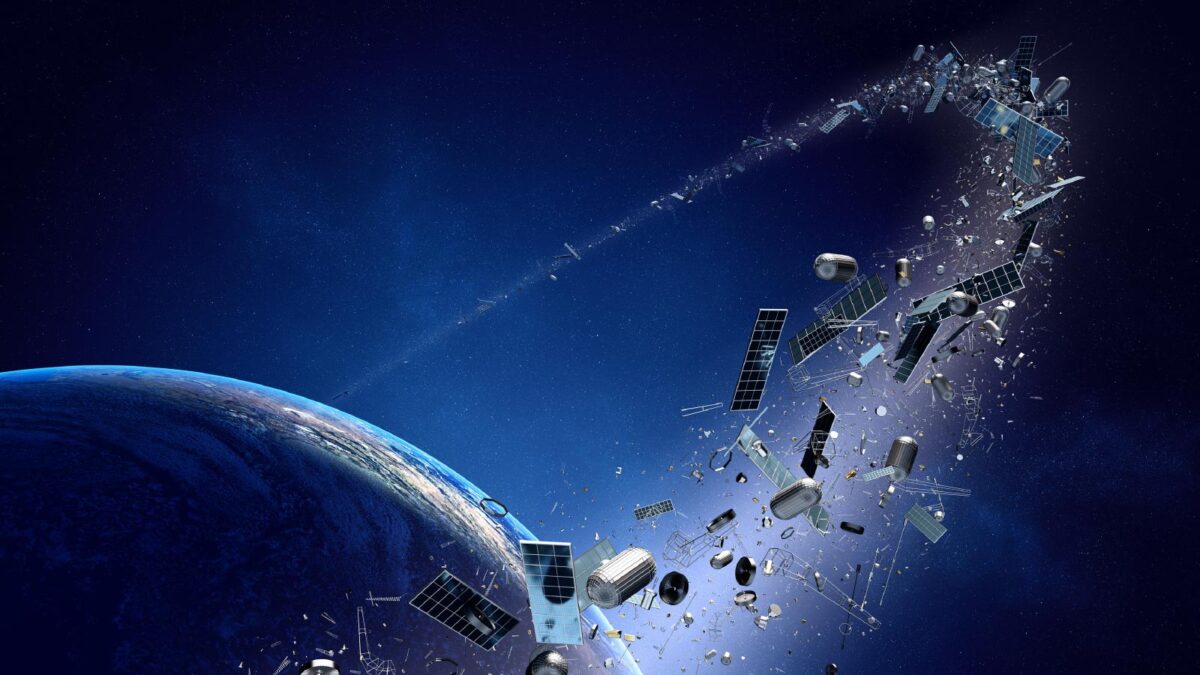
A NASA map showing man-made orbital debris in low Earth orbit. (©NASA/Roger Ressmeyer/Corbis. Reproduced by permission.)
A NASA map showing man-made orbital debris in low Earth orbit. (
©NASA/Roger Ressmeyer/Corbis. Reproduced by permission.
)
fragmentation debris table, the vast majority are “debris”—only about 5 percent of objects in orbit represent operational payloads or spacecraft. Also, of the approximately 28,000 objects that have been tracked, beginning with the launch of Sputnik 1 in October 1957, those not accounted for in the fragmentation debris table have either reentered the earth’s atmosphere or have escaped the earth’s influence (to land on Mars, for example). The distribution of debris smaller than 10 cm is predicated on the orbits of the parent objects and is assumed to be very similar to the distributions presented in the image of space debris around Earth.
Remediation Strategies
Remediation takes two courses: protection and mitigation. Protection seeks to shield spacecraft and utilize intelligent design practices to minimize the effects of debris impact. Mitigation attempts to prevent debris from being created. Active mitigation techniques include collision avoidance between tracked and maneuverable objects and the intentional reentry of objects over the oceans. Passive techniques include venting residual fuels or pressurized vessels aboard rockets and spacecraft, retaining operational debris, and placing spacecraft into disposal orbits at the end of a mission. Space salvage or retrieval, while an option, is currently too expensive to employ on a regular basis.
The United States and international space agencies recognize the threat of debris and are cooperating to limit its environmental and health hazards. The Interagency Space Debris Coordination Committee (IADC), sponsored originally by the National Aeronautics and Space Administration (NASA), has grown to include all major space-faring nations. The IADC charter includes the coordination and dissemination of remediation research, and strategies based on research results are being adopted by the worldwide space community.
Remediation strategies have resulted in a decline in the rate of debris growth in the 1990s although the overall population continues to grow. Continued work is necessary, however, to reduce the orbital debris hazard for future generations and continue the safe, economical utilization of space.
My name is goutham Kumar,I am from ballari, at present I am studying at Banglore pursuing B-TECH in presidency University Electrical and communications ,I love writing blogs n traveling

SPACE POLLUTION
Space debris encompasses both small natural (micrometeoroids) and artificial (man-made) particles floating in space. It’s notable because it represents a risk to spacecraft.[1] It is sometimes referred to as Micrometeroid and Orbital Debris (MMOD). Orbital debris refers to any man-made object orbiting the Earth which no longer serves a useful function. This can include nonfunctional spacecraft, abandoned launch vehicle stages, mission-related debris and fragmentation debris. This orbital debris is sometimes referred to as “space junk”.
Several spacecraft, both manned and unmanned, have been damaged or destroyed by space debris. For this reason, in 1979 NASA founded the Orbital Debris Program to adopt mitigation measures for space debris in earth orbit, which is mostly orbital debris.[2][failed verification]
As of 5 July 2016, the United States Strategic Command tracked a total of 17,852 artificial objects in orbit above the Earth,[3] including 1,419 operational satellites.[4] However, these are just objects large enough to be tracked. As of January 2019, more than 128 million bits of debris smaller than 1 cm (0.4 in), about 900,000 pieces of debris 1–10 cm, and around 34,000 of pieces larger than 10 cm were estimated to be in orbit around the Earth.[5] Collisions with debris have become a hazard to spacecraft; they cause damage akin to sandblasting, especially to solar panels and optics like telescopes or star trackers that cannot be covered with a ballistic Whipple shield (unless it is transparent).[6]
Below 2,000 km (1,200 mi) Earth-altitude, pieces of debris are denser than meteoroids; most are dust from solid rocket motors, surface erosion debris like paint flakes, and frozen coolant from RORSAT (nuclear-powered satellites). For comparison, the International Space Station orbits in the 300–400 kilometres (190–250 mi) range, and the 2009 satellite collision and 2007 antisat test occurred at 800 to 900 kilometres (500 to 560 mi) altitude.[7] The ISS has Whipple shielding; however, known debris with a collision chance over 1/10,000 are avoided by maneuvering the station.
The Kessler syndrome, a runaway chain reaction of collisions exponentially increasing the amount of debris, has been hypothesized to ensue beyond a critical density. This could affect useful polar-orbiting bands, increases the cost of protection for spacecraft missions and could destroy live satellites. Whether Kessler syndrome is already underway has been debated.[8][9] The measurement, mitigation, and potential removal of debris are conducted by some participants in the space industry.
my name is Harish v I am from Bangalore and I am perusing b tech in presidency university civil engineering and my hobbies are watching movies and playing games an I love travelling and music

SPACE POLLUTION
In the most general sense, the term space pollution includes both the natural micrometeoroid and man-made orbital debris components of the space environment; however, as “pollution” is generally considered to indicate a despoiling of the natural environment, space pollution here refers to only man-made orbital debris. Orbital debris poses a threat to both manned and unmanned spacecraft as well as the earth’s inhabitants.
The effects of debris on other spacecraft range from surface abrasion due to repeated small-particle impact to a catastrophic fragmentation due to a collision with a large object. The relative velocities of orbital objects (10 kilometers per second [km/s] on average, but ranging from meters per second up to 15.5 km/s) allow even very small objects—such as a paint flake—to damage spacecraft components and surfaces. For example, a 3-millimeter (mm) aluminum particle traveling at 10 km/s is equivalent in energy to a bowling ball traveling at 60 miles per hour (or 27 m/s). In this case, all the energy
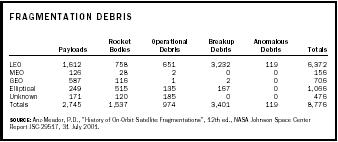
FRAGMENTATION DEBRIS
| Payloads | Rocket Bodies | Operational Debris | Breakup Debris | Anomalous Debris | Totals | |
| LEO | 1,612 | 758 | 651 | 3,232 | 119 | 6,372 |
| MEO | 126 | 28 | 2 | 0 | 0 | 156 |
| GEO | 587 | 116 | 1 | 2 | 0 | 706 |
| Elliptical | 249 | 515 | 135 | 167 | 0 | 1,066 |
| Unknown | 171 | 120 | 185 | 0 | 0 | 476 |
| Totals | 2,745 | 1,537 | 974 | 3,401 | 119 | 8,776 |
| SOURCE: Anz-Meador, P.D., “History of On-Orbit Satellite Fragmentations”, 12th ed., NASA Johnson Space Center Report JSC-29517, 31 July 2001. |
would be distributed in an area of the same size as the particle, causing cratering or penetration, depending on the thickness and material properties of the surface being impacted. There has been one accidental collision between cataloged objects to date, but surfaces returned from space and examined in the laboratory confirm a regular bombardment by small particles. Space Shuttle vehicle components, including windows, are regularly replaced due to such damage acquired while in orbit. Debris also poses a hazard to the surface of the Earth. High-melting-point materials such as titanium, steel, ceramics, or large or densely constructed objects can survive atmospheric reentry to strike the earth’s surface. Although there have been no recorded fatalities or severe injuries due to debris, reentering objects are regularly observed and occasionally found.
Debris is typically divided into three size ranges, based on the damage it may cause: less than 1 centimeter (cm), 1 to 10 cm, and larger than 10 cm. Objects less than 1 cm may be shielded against, but they still have the potential to damage most satellites. Debris in the 1 to 10 cm range is not shielded against, cannot easily be observed, and could destroy a satellite. Finally, collisions with objects larger than 10 cm can break up a satellite. Of these size ranges, only objects 10 cm and larger are regularly tracked and cataloged by surveillance networks in the United States and the former Soviet Union. The other populations are estimated statistically through the analysis of returned surfaces (sizes less than 1 mm) or special measurement campaigns with sensitive radars (sizes larger than 3 mm). Estimates for the populations are approximately 30 million debris between 1 mm and 1 cm, over 100,000 debris between 1 and 10 cm, and 8,800 objects larger than 10 cm.
The number, nature, and location of objects greater than 10 cm in size are provided in the fragmentation debris table and in the image of space debris around Earth. Low Earth orbit (LEO) is defined as orbital altitudes below 2,000 km above the earth’s surface and is the subject of the image of space debris around Earth. Middle Earth orbit (MEO) is the province of the Global Positioning System (GPS) and Russian navigation satellite systems and is located at approximately 20,000-km altitude, whereas the geosynchronous Earth orbit (GEO) “belt” is inhabited primarily by communications and Earth—observation payloads around 35,800 km. The majority of objects in these orbital regions are in circular or near-circular orbits about the earth. In contrast, the elliptical orbit category includes rocket bodies left in their transfer (payload delivery) orbits to MEO and GEO as well as scientific, communications, and Earth-observation payloads. Of all objects listed in the
Read more: http://www.pollutionissues.com/Re-Sy/Space-Pollution.html#ixzz67xlpa3kW

I am Farhan Shariff pursuing B.tech at Presidency University . I like to play football and listen to music .
Space Pollution
In 2009, nearly 500 miles above Siberia, two satellites collided at some 22,300 mph, bursting into a cloud of thousands of pieces of debris. The culprits of this high-speed accident were the inactive Russian satellite Cosmos 2251 and the active U.S.-based communication satellite Iridium 33. Their catastrophic end was the first known time that two satellites collided in space, and a startling reminder of the growing problem of space junk. More than 23,000 known man-made fragments larger than about 4 inches, which is a little wider than two golf balls across, zip around our planet. But those are just the pieces large enough to track. An estimated 500,000 pieces between 0.4 inches and 4 inches across join those larger fragments. Most of that debris sits within 1,250 miles of Earth’s surface in what is known as low Earth orbit, home to lots of satellites, such as NASA’s Earth Observing System fleet and the International Space Station. And while space is big—so even 23,000 fragments tend to be far from each other—even the tiniest bits of man-made flotsam can be problematic for active earth orbiters because of their breakneck speeds. Space junk can impact other objects at over 22,300 mph, faster than a speeding bullet. Collisions with those tiny pieces often leave pits and dings in the many satellites, telescopes, and other objects orbiting our planet. In 2006, for example, a tiny piece of space junk collided with the International Space Station, taking a chip out of the heavily reinforced window.
My name is shri krishna. I am the person who woke up everyday to hustle harder than yesterday. I believe in hard work rather than anything. Love to lost in my thoughts. Always wondering how these universe is working and finding answer for it. I am a problem solver, gamer, memer.
Music+ window seat+ traveling = infinite satisfaction.
A smile in face, active mind, being proud of myself, and infinite kindness in heart completes me. Okay that’s enough about myself now please read mine useful article and think on it.


Space debris encompasses both small natural and artificial (man-made) particles floating in space. It’s notable because it represents a risk to spacecraft. It is sometimes referred to as Micrometeroid and Orbital Debris (MMOD). Orbital debris refers to any man-made object orbiting the Earth which no longer serves a useful function. This can include nonfunctional spacecraft, abandoned launch vehicle stages, mission-related debris and fragmentation debris. This orbital debris is sometimes referred to as “space junk”.
Several spacecraft, both manned and unmanned, have been damaged or destroyed by space debris. For this reason, in 1979 NASA founded the Orbital Debris Program to adopt mitigation measures for space debris in earth orbit, which is mostly orbital debris.
As of 5 July 2016, the United States Strategic Command tracked a total of 17,852 artificial objects in orbit above the Earth, including 1,419 operational satellites. However, these are just objects large enough to be tracked. As of January 2019, more than 128 million bits of debris smaller than 1 cm (0.4 in), about 900,000 pieces of debris 1–10 cm, and around 34,000 of pieces larger than 10 cm were estimated to be in orbit around the Earth. Collisions with debris have become a hazard to spacecraft; they cause damage akin to sandblasting, especially to solar panels and optics like telescopes or star trackers that cannot be covered with a ballistic Whipple shield (unless it is transparent).
Below 2,000 km (1,200 mi) Earth-altitude, pieces of debris are denser than meteoroids; most are dust from solid rocket motors, surface erosion debris like paint flakes, and frozen coolant from RORSAT (nuclear-powered satellites). For comparison, the International Space Station orbits in the 300–400 kilometres (190–250 mi) range, and the 2009 satellite collision and 2007 antisat test occurred at 800 to 900 kilometres (500 to 560 mi) altitude.[7] The ISS has Whipple shielding; however, known debris with a collision chance over 1/10,000 are avoided by maneuvering the station.
The Kessler syndrome, a runaway chain reaction of collisions exponentially increasing the amount of debris, has been hypothesized to ensue beyond a critical density. This could affect useful polar-orbiting bands, increases the cost of protection for spacecraft missions and could destroy live satellites. Whether Kessler syndrome is already underway has been debated. The measurement, mitigation, and potential removal of debris are conducted by some participants in the space industry
Have a WordPress.com account? Log in now.


